FTWkit has combined the benefits of a unified software platform like Rhino with the specialized tools needed for the footwear industry.
This integration optimizes the entire footwear development process from 2D and 3D design to engineering and product pipeline management, including cost and material management.
With Jevero and Botcha, two FTWkitplugins, you can streamline your workflow, shorten the time to market, and reduce the complexity of managing multiple software programs without sacrificing the specific tools necessary for 2D and 3D shoe modeling and engineering.
Jevero is a 2D footwear pattern engineering plugin for Rhinoceros. It allows you to create and modify patterns easily and efficiently, seamlessly integrating with Rhino and adding powerful parametric tools for smooth pattern development. Jevero supports all major file extensions on the market, including Crispin Engineer .shoe and .pat files, ensuring a quicker transition and support for your legacy files.
Botcha simplifies 3D footwear modeling, enabling users to model in 2D and remap in 3D with a vast array of efficient tools that make every designer’s life easier. With Botcha andRhino, you can quickly create digital uppers, parametrically edit each part, and apply textures to the model. Flatten any object, apply texture and remapping, and easily create lacing and stitching. These features allow you to achieve stunning results to help sell your projects and products.
The Institute for Advanced Architecture of Catalonia (IAAC) in Barcelona just introduced a new edition of the Global Summer School (GSS), marking another milestone in fostering global collaboration and innovation in architecture and design.
For over 14 years, IAAC has been facilitating knowledge exchange and expertise sharing among architects, engineers, designers, and innovators worldwide. The GSS brings together students from diverse backgrounds to engage with IAAC's network of experts and renowned lecturers.
This July, IAAC introduces a new edition of GSS, offering a unique blend of onsite and online workshops. The modular workshop model aims to provide participants with hands-on experiences at IAAC Barcelona while ensuring digital accessibility through an agile online format.
GSS24 presents an exciting lineup of four workshops covering various topics, including the exploration of bamboo architecture and fabrication, advanced computation, urban analytics for participatory design, and artificial intelligence. These workshops, led by IAAC Faculty and Alumni, promise immersive workflows and individual project exploration and development.
Participants in the GSS program will have the flexibility to tailor their learning journey according to their preferences. Whether opting for a two-week onsite workshop in Barcelona at IAAC or selecting one or more online modules offered throughout July 2024, students can expect a dynamic and enriching educational experience.
One of the highlights of GSS24 is the exclusive access to Global Lectures and weekly online gatherings featuring experts from the Architecture, Engineering, and Construction (AEC) industry. These sessions complement the workshop themes and provide participants with valuable insights and perspectives.
The workshop will explore the convergence of parametric tools, digital fabrication, and prototyping within the environment of IAAC Barcelona and Valldaura Labs. It welcomes creatives from architecture, urban planning, digital fabrication, and design seeking a multidisciplinary experience in an international setting.
Dates: 1-12 July 2024 Venue: IAAC Barcelona (Spain)
During the workshop, participants will explore the convergence of advanced computational design, machine learning, and environmental analysis in architecture powered by Python. Students will unlock the potential of data-centric models and Python-based algorithms to revolutionize architectural practice, prioritizing sustainability and environmental considerations.
The workshop will explore the integration of public participation with digital innovation in urban design, develop urban analytics for participatory design, collect and map citizen inputs for data-driven design of public spaces, and equip students with the skills to engage communities and apply technology in co-designing inclusive urban spaces.
In the workshop, students will use cutting-edge AI tools including infrared.city for real-time microclimate simulations, multi-modal large language models, stable diffusion models, and advanced computer vision models to develop innovative design workflows for sustainable architectural solutions.
Dates: 15-19 July Venue: Online
The deadline for applications with the early bird fees is May 31st.
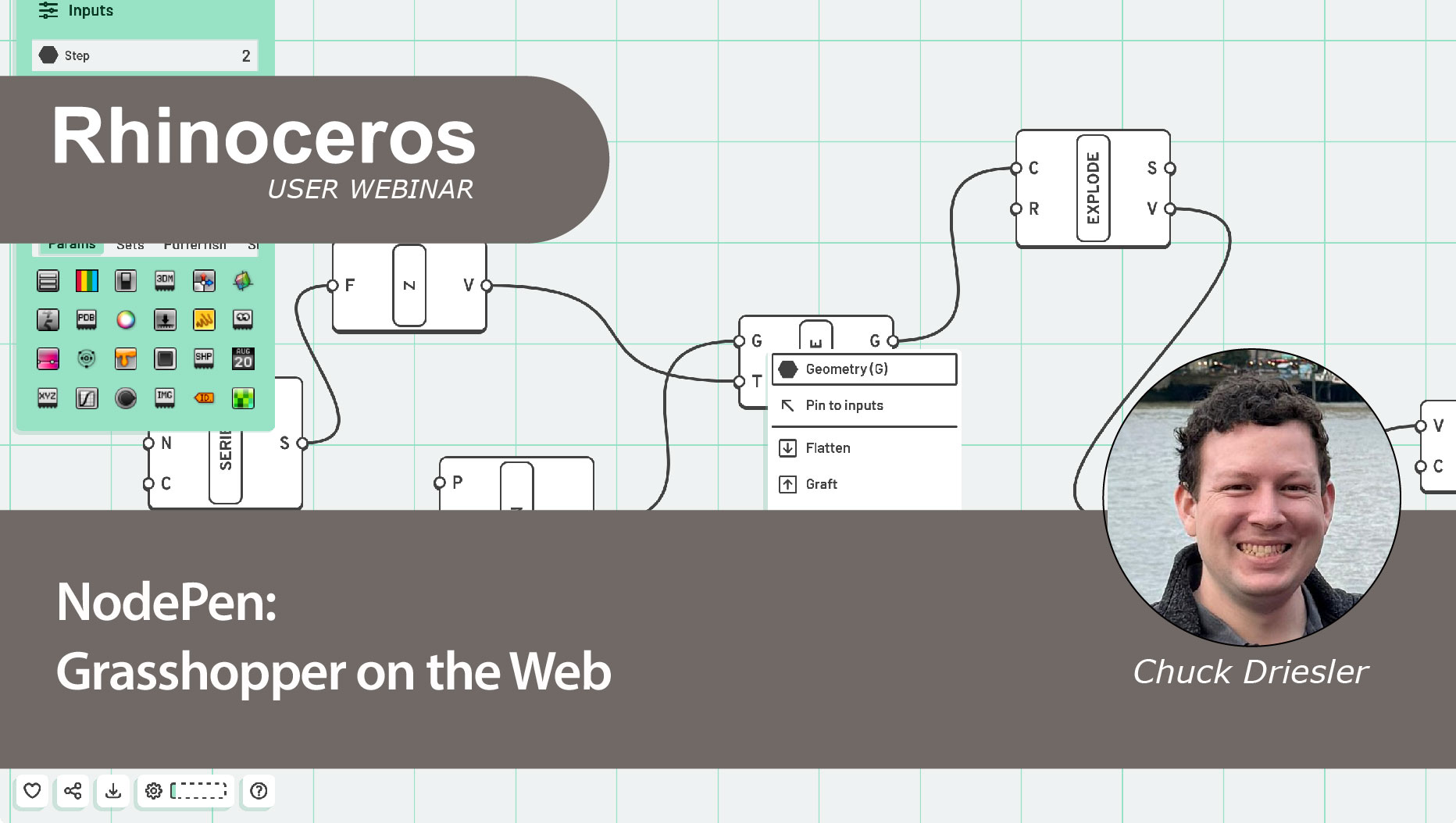
NodePen is Grasshopper on the Web and is also perpetually unfinished. It has been in development since the earliest versions of Rhino Compute, and over the years, it has taken on many forms and attitudes on the problem of web-flavored Grasshopper.
This webinar will be a more technical exploration of the history of the project's many revisions, detailing the goals, challenges, and successes. We will end with a demo of where things stand today and some of the latest thoughts on where things are going. Where does a project like this belong in a world with successful offerings like Grasshopper 2 and ShapeDiver? What has Speckle unlocked for the future of a collaborative "platform" for Grasshopper? And what unhinged things will Chuck say about a project he refuses to let die?
About the speaker:
Chuck Driesler graduated with a B.Arch from Pratt Institute in 2019. He has worked on several technical teams within the AEC community, including HOK buildingSMART, WeWork, Pollination Tools, and Hypar. He recently moved to London and is currently a software engineer at Speckle.
This webinar aims to provide an overview of how Rhino is integrated into Saitec’s workflow during the design process of a floating offshore wind platform. The presentation will showcase the parametric script developed in-house using RhinoScript module, and introduce the detailed 3D model that represents the "as-built" status of DemoSATH. Saitec will also give some feedback on the advantages of using this software against others and its capabilities.
Saitec Offshore Technologies, founded in 2016 as a spin-off of Saitec Engineering, is an engineering company specialized in floating offshore wind related services. It has developed SATH technology (Swinging Around Twin Hull), a competitive and cost-efficient concrete floating solution. In 2023 Saitec achieved a major milestone by putting into operation DemoSATH, the first floating offshore wind turbine connected to the grid in Spain.
About the speakers:
Oriol de Quintana holds an MSc in Civil Engineering from Universitat Politècnica de Catalunya (UPC), specializing in Maritime and Offshore structures. He joined Saitec in 2023, and he has been involved in the platform design.
Mikel Baliño is a BIM modeler with extensive experience in large-scale projects in the industry and energy sectors. He has honed his skills in 3D modeling through completion of an Autodesk BIM master's program.
We’ll have our presentations at the meeting, followed by an audience Q&A with all our presenters. Attendees are then invited to stay on for conversation and networking opportunities with the UK Grasshopper community as we gather and drink together.
This beginner-level video, created by Phil Cook from Simply Rhino UK, demonstrates how to create an interior architectural visual in Rhino 8 using the built-in Sun and Sky system and Rhino’s Raytrace render engine.
The video begins by introducing a method of setting up the interior perspective view by controlling Rhino’s camera widget before applying library and custom materials to scene elements.
Phil then looks at setting up the Sun as a direct illumination source and replacing the default environment with the Physical Sky model to connect the sun and sky.
The final rendering is created with the Raytrace render engine. Phil outlines how to use post effects to improve the exposure and how to export a transparent background so that the color-ramp sky can be easily replaced with a photographic image in subsequent editing.
Human UI、UI+、あるいは別のインターフェイスプラグインを使って、プレゼンテーションや技術関係以外の同僚と共有するためのカスタムインターフェイスを作ったことはありますか? それらのツールは素晴らしいものですが、Rhinoライセンスを持っていないユーザーと使いやすいインターフェイスを共有したい、Grasshopper定義を共有せずにアプリケーションへのアクセスを提供したい、スマートフォンを含めあらゆるデバイスでアクセスできるようにしたい、といった時など、内容によっては制限が残ってしまいます。




.jpg)
.jpg)


 購読
購読

 投稿
投稿

